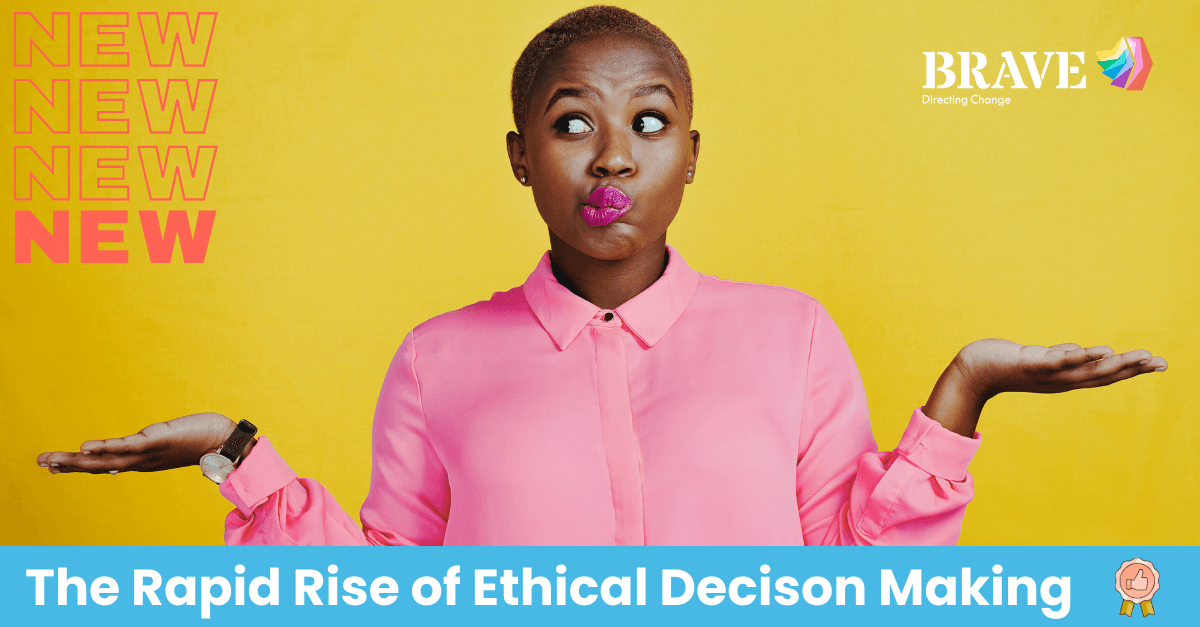
In 2026, ethical decision making is no longer a “nice to have” or a compliance module buried in an LMS. It’s becoming the heartbeat of many organisational cultures, the place where trust is either built or quietly eroded. And for a training business like ours, one that spends its days helping people speak up, disagree well, and be brave, this moment feels both urgent and full of possibility. Let us tell you why:
Because silence is no longer neutral
When people don’t feel safe to question a decision, challenge an assumption, or name a risk, businesses can drift into ethical blind spots. Not because anyone is malicious, but because fear is louder than integrity. We see it every day: talented people holding back insights that could prevent harm, spark innovation, or protect a team’s reputation.
Ethical decision‑making starts with the courage to say, “I see something — can we talk about it?”
Because complexity demands more than technical expertise
Brave leaders are navigating dilemmas with no clean answers: AI bias, data privacy, climate impact, hybrid‑work fairness. These aren’t problems you can solve with a policy alone.
They require teams who can slow down, think critically, disagree constructively, and bring to the surface perspectives that would otherwise stay hidden.
Ethical decisions are rarely made by the loudest voice in the room; they’re made by the most inclusive one.
Because values only matter when they’re lived out loud
Organisations are being asked to “show their working”, in order to demonstrate not just what they decided, but how they got there.
That level of transparency is impossible without a culture where people feel able to question, challenge, and contribute.
Speaking up isn’t a disruption to ethical decision‑making; it’s the engine of it.
Because bravery is a skill, not just a personality trait
We train people every day who think bravery belongs to someone else, the extroverts, the senior leaders, the C-Suite, the natural born disruptors. But ethical decision‑making thrives when bravery is distributed, not concentrated. It could look like:
Asking the awkward question
Naming the tension everyone feels
Challenging a decision respectfully
Admitting uncertainty
Holding a boundary
These are learnable behaviours. And when teams practise them, ethical clarity becomes a collective habit rather than a heroic exception.
Because the future will reward businesses who choose integrity over ease
The organisations that will thrive in 2026 and beyond are the ones who treat ethics as a living practice, something that is shaped by everyday conversations, not annual statements. And that’s why our work matters. Every workshop, every coaching session, every moment where someone finds their voice contributes to a culture where ethical decisions aren’t left to chance.
Ethical decision‑making isn’t abstract. It’s human. It’s relational. And it starts with the courage to speak up, even when your voice shakes.
Interested in us supporting you? We’d love to help. Start the conversation today.