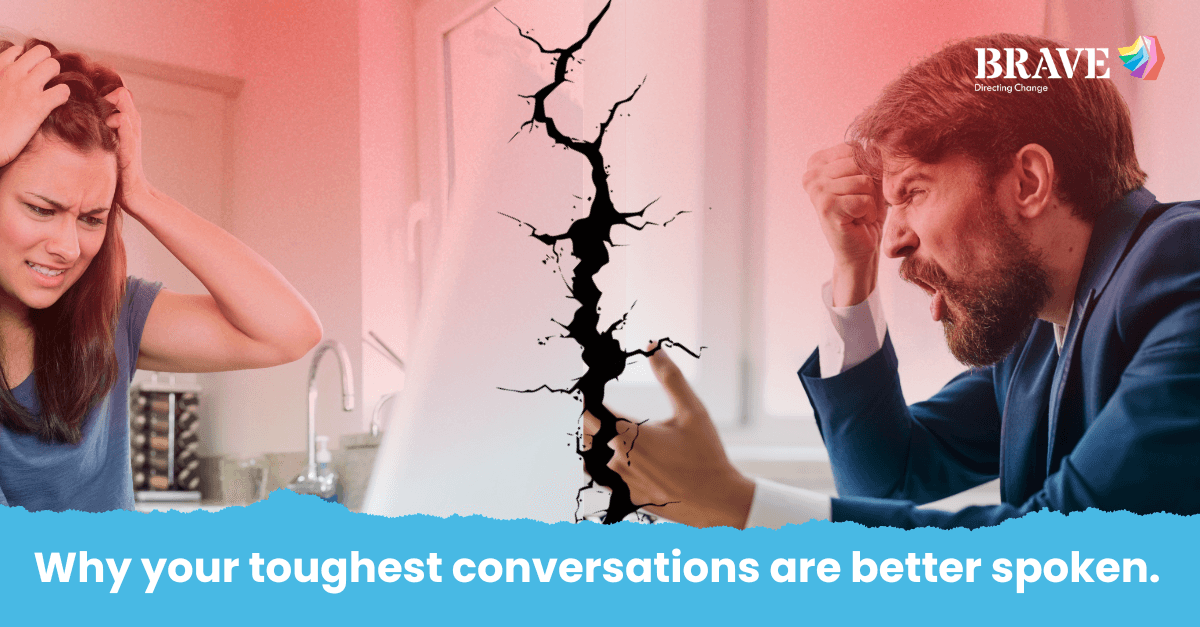
Why your toughest conversations are better spoken.
At We Are Brave we’re trying to help people see that disagreement doesn’t have to mean dislike, and that when you speak up and debate with purpose you improve the outcomes for all. It’s our ethos!
But, in the real world, humans have built a world where disagreement is easy to avoid in person if you want to. No awkward pauses, no raised voices, just a screen and time to think. In 2026, many disagreements happen through messages, emails, or posts, rather than face-to-face.
(Did someone say ‘keyboard warrior’?)
That shift might feel like real progress to some. We can understand why, but the evidence suggests otherwise.
Recent research finds that when disagreeing, speaking with someone versus using written communication makes them more likely to understand you. Burint Bevis and the team from Imperial College London and the University of California, Berkeley would argue that simply changing the conversation medium in which disagreement takes place can have a positve effect on its outcome.
The medium matters more than we think
Across a series of experiments involving more than 1,500 participants, researchers compared conversations between people who disagreed on political and social issues. Some spoke, others wrote.
The pattern was consistent. People who spoke tended to:
- report greater understanding
- experience less conflict
- come away with more favourable impressions of the other person
- show more movement in their views
Those who wrote generally saw weaker versions of these outcomes. The differences are not dramatic in every case, but they are consistent enough to matter.
What speaking does differently
One explanation seems to be something called conversational receptiveness, language that signals openness and a willingness to engage with another person’s point of view.
People appear to use more of this kind of language when they speak. When we dleiver our Speak modules, this is one of the things we cover.
That may be because conversation demands it. Tone, timing, even small hesitations can make it easier to signal interest or acknowledge the other side. Writing, by contrast, can become more controlled and more guarded.
Interestingly, when people do use receptive language in writing, it appears to help. They just tend to do it less often.
People still choose the wrong channel
Despite this, most people say they would choose writing if they expected a disagreement. Only a small minority prefer speaking or video. Researchers suggest this may be because writing feels more manageable. It gives people space to think, edit, and avoid being put on the spot.
That instinct makes sense. It just doesn’t seem to lead to better outcomes.
What this means in practice
The conversations in the study were fairly low stakes, often between strangers, with limited emotional intensity. That leaves open the question of whether the same pattern holds in more personal or heated situations. Even so, the direction is clear.
If your goal is to be understood, and to understand someone else, speaking appears to give you a better chance than typing.
The next time a conversation starts slipping into disagreement, it might feel natural to keep typing….but it might just be worth picking up the phone instead.
If you think we can help you develop your speaking or disagreement skills, then get in touch. I’d love to hear from you.
Rhi Baxter
Credit
If you’re interested in the full paper you can find that here: Spoken disagreement is more constructive than written disagreement | Nature Communications