We’ve all sat through communication that was technically correct… and completely forgettable.
Clear, concise, accurate…and somehow still feels flat.
Then someone tells a story, shares a moment, describes a scene, makes you feel a feeling. And that’s when the whole room shifts. People lean in. They remember. They care.
That’s the power of storytelling.
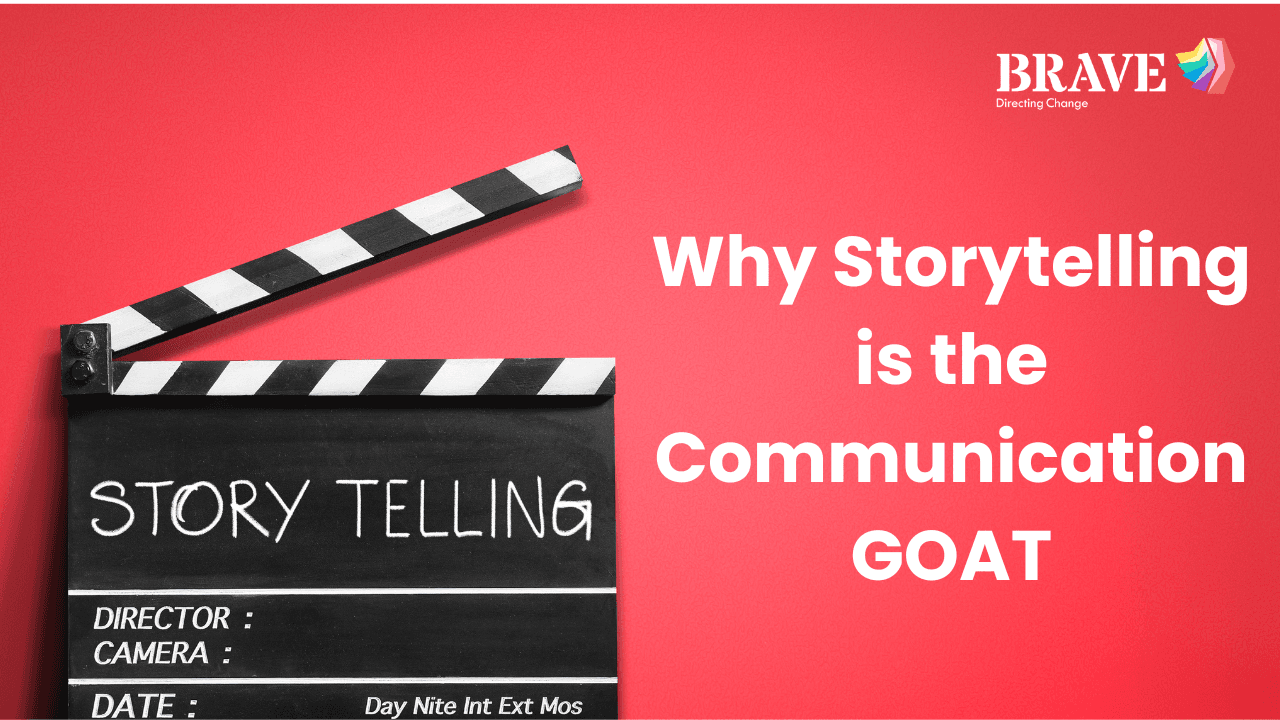
Not as performance. Not as theatrics. But as meaning‑making. And it’s why storytelling is often seen as the greatest of all time skills.
When it comes to communication, in a world where attention is scarce and information is overwhelming, storytelling isn’t a “nice to have”. It could be the thing that makes your message land.
Storytelling Is Already Everywhere. You Just Don’t Notice It
You’re surrounded by storytelling every day. It’s how humans make sense of the world. Don’t believe us? Let us prove our point.
Healthcare: Doctors explain treatment plans through patient stories “I had someone last month with the same symptoms…” because stories build trust faster than data.
Politics: Leaders don’t just present policies; they tell stories of “the family I met in Manchester” because stories humanise complexity.
Sport: Coaches use stories of past comebacks to shift belief and energy in the team.
Parenting: Kids don’t respond to instructions; they respond to stories “Remember what happened last time you didn’t wear your coat…”
Work: The colleague who gets buy‑in isn’t the one with the best slide deck. It’s the one who says, “Let me tell you what happened when we tried this last year.”
Storytelling is not a creative superpower. It’s a human default. You most likely already use it. Now the trick is to start it’s using it on purpose.
The BRAVE 5‑Step Storytelling Process
This is a lightweight structure anyone can use and absolutely no drama school attendance required.
Start with the moment, not the message
Most people start with the point they want to make. Storytellers start with the moment that brings the point to life. Ask yourself some key questions about what you are trying to communicate.
What moment changed something for me? Was it a conversation, a mistake, a turning point or an ‘aha’ moment. That is your anchor.
Set the scene in one sentence
You don’t need a novel. You need context. One sentence is usually enough. Here’s a fe examples:
“Last year, during a project that was going off the rails…” “Five minutes before the meeting started…” When I first became a manager…”
What you do here is set the scene. Scene = relevance and importantly, relevance = attention.
Share the tension (the human bit)
Every good story has a “something was at stake” moment. It doesn’t need to be dramatic. It just needs to be human. Nine times out of ten you’ll need to be honest, and you might need to be more open than you are usually, but trust us, it works.
The kind of things you might share are “I didn’t know what to say” or “I realised I’d been avoiding the real issue” or “I could feel the team losing confidence”
This is real. This is tension we have all experienced. Tension is what makes people care.
Reveal the shift
This is the moment something changed, it could be your insight, your learning or even your realisation. It’s the emotional payoff.
This might sound like “That’s when I realised clarity wasn’t the problem, courage was” or “I understood that people weren’t resisting the idea; they were resisting the way I was communicating it” or “I saw that the story I was telling myself was holding the team back”
The shift here is what makes the story so meaningful.
Land the message in one clean line
This is where you connect the story to your point. Keep it super simple. One sentence.
Make sure it’s clear, direct, no fluff or filler. It could look like this:
“That’s why clarity matters more than confidence” or “That moment taught me that people follow honesty, not polish” or “It reminded me that communication is a shared act, not a solo performance.”
This is the line people will walk away and remember.
Why This Works
Because stories bypass resistance. They make your message relatable, memorable, and emotionally resonant. We live in a world crwoded with data right not. Data informs but it doesn’t move you. Stories do.
At We Are Brave we know that when people are overloaded, distracted, and sceptical, the storyteller who can tell a simple, honest, human story is the one who stands out. The good news? We can help you become that storyteller.
Get in touch today. We’d love to chat.
You can download the The BRAVE 5‑Step Storytelling Process Infographic here.