We spend a lot of time in business fixing the wrong thing. Better processes, clearer strategies, more training. But walk into most organisations and the real problem isn’t hard to spot — it’s the conversations that aren’t happening.
Picture a stereotypical leadership meeting. The agenda was circulated in advance. Slide deck on the screen. People say the right things, someone summarises the actions, and everyone moves on. Two weeks later, the same item is back on the agenda. Nothing moved. The needle stayed the same, but nobody’s quite sure why.
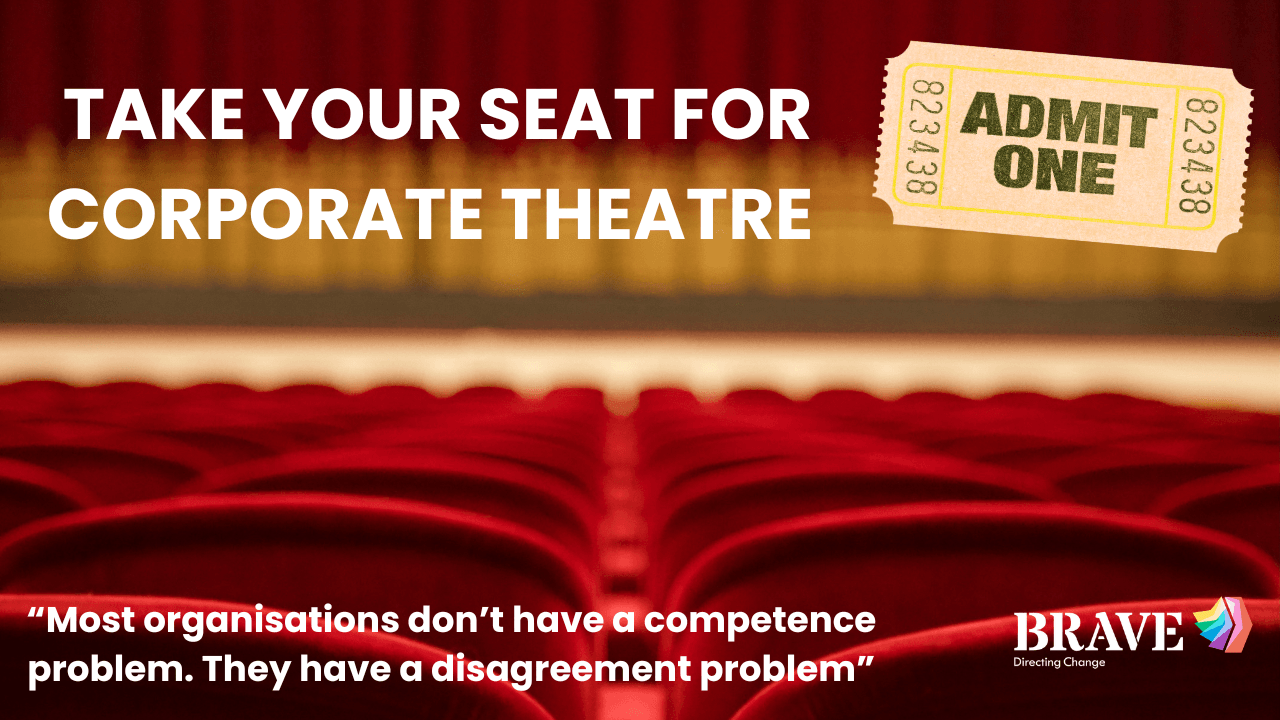
This is corporate theatre.
Let’s be clear, this is NOT deliberate dishonesty. It’s just the deeply human tendency to perform productivity rather than do the messy, uncomfortable work of genuinely disagreeing with each other. It happens everywhere, at every level, in organisations that would absolutely describe themselves as open and collaborative.
The root cause is almost always fear. Fear that if you push back too hard, it’ll get personal. Fear that challenging a colleague’s idea means challenging them. Fear that once a difficult conversation starts, nobody knows where it ends. So people hold back. They soften the message, read the room, and say something everyone can live with rather than something that’s actually true.
“Most organisations don’t have a competence problem. They have a disagreement problem.”
What avoidance actually costs you
There’s a version of conflict avoidance that looks, on the surface, like professionalism. Keeping things calm. Not making it awkward. Picking your battles. And sometimes that’s exactly right.
But when it becomes the default, and when topics quietly become undiscussable, or only in hushed ‘corridor conversations’, the cost adds up fast. Decisions get made without the full picture, because the people who had doubts didn’t feel safe voicing them. Teams go round in circles, relitigating things that should have been settled months ago. And the people with the sharpest instincts and most useful perspectives learn, through experience, that speaking up…well, it’s just not worth it.
The businesses most committed to avoiding conflict are often the ones drowning in it. It’s just gone deep underground. It shows up as disengagement, as office politics, as the slow drip of good people deciding they’d rather work somewhere else.
A different way to work
We are not here to make conflict more comfortable to ignore. Our work is about something more useful: helping leadership teams learn to disagree well. Giving you rhe skills, and the confidence required to hold truly difficult conversations without them turning into difficult relationships. We are here to help you build the kind of culture where the truth gets said in the room, not in the car park or venting phone call afterwards.
Our proven methodology is built around four principles that have been helping our cliemts get better at this for years. It’s not a checklist, but in fact it becomes a deep seated way of working that, over time, will change how a team actually functions.
Think BRAVE
Before you can change how a team communicates, you have to understand how they think. This is about identifying the habits, assumptions and blind spots that shape, and then often limit the decisions leaders make.
Speak BRAVE
Most people have more to say than they let on. Speak BRAVE is about finding the voice you’ve been editing, and using it in a way that people actually want to hear. Debate taken seriously, not personally.
Disagree BRAVE
Disagreement, done well, is how good ideas survive bad ones. This is where teams learn to challenge each other with purpose and to separate the argument from the person making it. It’s leanring that disagreemt does not mean dislike.
Decide BRAVE
Debating without decision is just noise. This principle gives teams a structure for actually landing somewhere and moving forward. It teaches them how to cleverly move from conversation to commitment, and doing so taking the right route rather than the path of least resistance.
It’s ok to be different
One thing worth saying plainly: if your team avoids difficult conversations, that’s not character flaws. It’s a learned response to environments where speaking up hasn’t historically gone well. The instinct to keep the peace is actually pretty reasonable. It’s just very time consuming & expensive.
The BRAVE approach doesn’t ask people to become confrontational, or to suddenly start saying things they’ve been holding back for years. It gives teams a way to work through tension before it spreads and helps leaders have the conversation that needs to happen, in a way that actually moves things forward.
Openness and transparency aren’t values you put on a wall. They’re the result of people having learned, over time, that it’s safe to say what they actually think. That’s what being BRAVE builds.
Find out where your team stands
We Are BRAVE work with leadership teams to shift the culture around disagreement, debate and decision-making in a way that sticks.
Take the BRAVE Readiness Assessment or book in for a no obligation call.