8 Things Brave Teams want from their Leader

When your team is behaving BRAVEly it’s super important that you realise the leadership they require has changed too.

More than ever they will need the right support, at the right time, and in the right way.

Find out the 8 things that brave team members want from their leader in this free downloadable resource.

It’s zero cost, easy on the eye 🥰 and useful for you and the team.

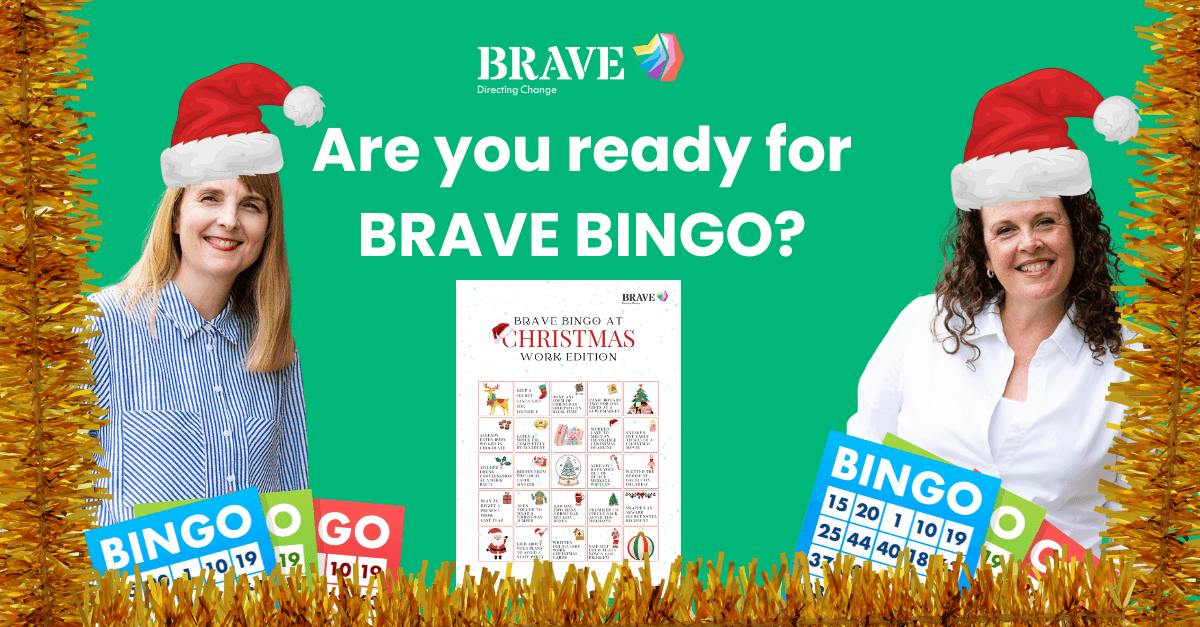
Are you ready for BRAVE Bingo?

Have some fun with your teams as the year starts to wrap up. Whether face to face or on a screen there’s bound to be some eye rolls and embarassing confessions with BRAVE Bingo. You’re welcome! 😉

Our Language does NOT define us.

Being born and raised in Brazil, I’ve spoken Portuguese for most of my life. Even though I studied English for a few years when I was a kid, it wasn’t enough to make me fluent or comfortable with the language at the time, but that was fine for me. It was only when I moved to Australia in 2017, that my “inner captions button” got switched on — and there I was, mentally subtitling myself and others… all…the…time.

I remember feeling constantly exhausted during the first years. It was like my brain was at the gym 12 hours a day. It was hard to fully understand others and be fully understood (on top of that, imagine Aussie slang being thrown at me like there was no tomorrow). For a long time, every time that I couldn’t speak the way I wanted, or couldn’t express myself the way I would in Portuguese, it made me feel frustrated, and worse… it made me feel LESS.

Not just because of the whole learning process – memorizing grammar rules, building a foundation with basic pronunciation and adapting to a totally different system of communication – but because it is hard to be fully ourselves. It can be really challenging to express our emotions or just act naturally while our brains are constantly over-analysing everything we say, write or hear.  

Now I feel more comfortable while speaking English because of the constant exposure to the language over the years. However, I also see that it is NOT about sounding like others, but instead, improving my communication skills while respecting my own style, cultural background and individualities.

I understand that my voice helped (and helps) me navigate through life and I do NOT need to sound and act like anyone else to feel MORE. My value lies in the unique way I sound, and every single vocal variation helps me tell my story. 

If you need to speak in a different language, remember: 

1.     You are more than the language(s) you speak;

2.     The way you sound does NOT define you;

3.     It is important to work on our communication skills, not to “blend in” with others, but to highlight your unique potential.

So, YES, let’s all embrace our unique voices to tell our stories… in our own ways.

Juliana

You can connect with our amazing Brave Associate on her LinkedIn account below:

Juliana Nogueira Mathew
Virtual Learning & The Power of Global Connection

As many businesses start to build and plan their 2026 people budgets, there could be a temptation to revert back to traditional, in-person learning experiences – especially as more teams return to office spaces.

In today’s global world the ability to connect teams across regions and cultures through virtual learning is a game-changer. It’s more than just convenience or cost saving it’s about fostering collaboration and shared understanding that transcends borders. We know that the more skilful your teams become at creating real connection via virtual platforms, the more possibilities will open up for your business.  It’s common sense.

You might say  what about the learning outcomes?  

Decades of high-quality research including a 2021 evidential review by the CIPD showed that the effectiveness of learning isn’t about the format, it’s about the design and delivery. Whether online or in-person, well-crafted learning experiences yield comparable outcomes. In fact, virtual classrooms can sometimes lead to greater learning gains especially when designed by experts who understand how to engage learners in a digital space.

The idea that virtual learning is inferior is pretty outdated. The pandemic may have reshaped how we work and learn but it also proved that virtual environments can be just as dynamic, interactive and impactful as face to face.

How do we we achieve this?

At We Are Brave, we’ve seen firsthand how powerful virtual learning can be. Our team’s depth of experience allows us to create sessions that are not only effective but genuinely engaging; something our clients consistently highlight in their feedback.

We don’t believe in one-size-fits-all solutions. Instead, we collaborate closely with our clients to design programmes that blend our learning expertise with their organisational goals. Whether it’s virtual, in-person or a hybrid approach, we make sure the format serves the purpose.

Our message to you.

As you plan your 2026 training budget don’t rush back to in-person by default. Virtual learning isn’t just a backup option, it’s really a strategic, effective and often magical way to grow your teams.

If you think we can help, we’d love to chat.

Start the conversation today.

Sara and Rhi.

You can get in touch here: www.wearebrave.co.uk/keeping-in-touch

Why you need Micro Learning

If you weren’t sure of the value of Micro Learning we’ve created you a downloadable cheat sheet to help swing the minds of even the strongest non believer!

We Are BRAVE has an extensive video micro leanring library and all you need to do to get unlimited access is susbcribe to our BRAVE Newsletter.

You can do that here: www.wearebrave.co.uk/keeping-in-touch

Why you need a BRAVE Coach

Whatever your need for coaching, we can help.

It could be because you have a specific goal in mind. Maybe you want to get focussed, or perhaps you simply prefer a more individual space to learn new skills and techniques?

What ever the reason, we offer one to one coaching sessions to help you THINK, SPEAK, DISAGREE and DECIDE BRAVE.

Don’t just take our word for it. Read our Case Studies to see what others have said.

12 Traits of BRAVE Team Members

They say managing a team is one of the hardest jobs you can do.

Making it effective and harmonious as well?…now that’s a tough one!

We know that by either recruiting for, or developing teams with 12 distinct Brave Traits will 100% help you lead an high performing team.

Check out this free downloadable resource, the 12 Traits of BRAVE Team Members, it’s super useful.

How Managers Can Use AI for Smarter Decision Making

In the age of algorithmic everything managers are increasingly turning to AI to support decision making in anything from forecasting sales to streamlining hiring.

Without a clear framework it can amplify bias, obscure accountability or lead teams astray with overconfidence in machine-generated outputs.

It’s so easy to simply take what AI says as correct but you only need to play around with it and feed in different information to realise the danger of automatic trust. Our favourite suggestions so far are using glue to make your pizza stick together, using petrol in cooking, eating rocks and the benefits of chewing tobacco 😱

Let’s pause here before we blame AI for all our crazy decision-making. We know it’s generative and it’s continually learning, it’s not a consistent recall system and it’s not meant to be so let’s not make it all AI’s fault!

We’d rather take a look at how a manager can get started on this journey to speed up some inputs and where we’d recommend slowing down, on purpose. For example; you could use AI in lower-risk areas to speed up automating reports or pulling together data but slow down the conversation about what that data means for you or your team.

What we think is exciting is it will give us more time to ensure there is plenty of cross-functional chat between the various data teams and frontline leaders. Less time spent in the gathering of data means it would be common sense to spend the remaining time in better conversations.

The most important outcome of AI is managers need to treat it not as a shortcut or a quick fix but as an assistant for deeper thinking.

So, let’s focus on how to help managers harness AI for derision making, without outsourcing their judgment? It starts with those five failsafe parameters we mentioned. They are simple, sturdy, and most importantly, non-negotiable.

Managers Must Use The Five Failsafe Parameters

      AI can suggest but it must never decide alone. Managers should treat AI as a strategic advisor not a final authority. Every recommendation needs a human checkpoint especially when decisions affect people, ethics, or long-term strategy.

      If you can’t explain how the AI reached its conclusion don’t act on it. Managers should prioritise tools that offer clear logic, traceable data inputs, and understandable outputs. This builds trust and enables well informed scrutiny.

      AI systems inherit the biases of their training data. Managers must regularly audit for skewed outcomes especially in areas like hiring, performance reviews, or data gathering. If the system favours one group over another it’s not just a tech issue, it’s an input error and the biased decision becomes a leadership failure.

        AI thrives on patterns but it doesn’t understand nuance. Managers must layer in context, market shifts, team dynamics, cultural factors; in fact anything that AI can’t grasp. A good decision blends data with lived experience, intuition, and strategic foresight.

        At We Are BRAVE we know that paying attention to your team’s critical decision-making and discussion skills, alongside proper insight and those sturdy parameters or guard rails means AI can assist you with better human decision making.

        Our Decide BRAVE module works perfectly as that elusive piece of the puzzle to offer the human input to support an artificial process.

        If you’d like to learn more, then reach out and start the conversation.

        We’d love to help.

        The 6 Skills That Will Matter in 2026

        If you strip away the constant ‘skills shortage’ noise, the tech hype, the AI takeover, the endless upskilling lists you’ll fine what remains are a handful of human capabilities that will quietly but powerfully shape the future of work over the next 12-18 months.

        Here’s what the team at We Are BRAVE are seeing emerge based on the conversations we’re having across industries, leadership circles and with our brilliant partners. These six skills aren’t just trending, they’re likely to be truly transformative.

          Forget the soft skill label. Emotional intelligence is widely and continually acknowledged as the backbone of effective leadership, especially in hybrid and high change environments. It’s not about being agreeable, it’s about being attuned. To us this looks like:

          • Spotting tension before it derails a team
          • Speaking up with feedback that lands and leads to real change
          • Building trust across cultures, time zones, and personalities
          • Managing your own emotional highs and lows while helping others regulate theirs too.
          • Being able to clearly switch positions to gain a sense of all perspectives.

          Give it a go.
          Try this: For one week, practice listening with zero agenda. No fixing, no advising just full presence. You’ll be surprised how quickly trust deepens.

            AI can optimise but humans are still the ones who can reimagine. The real edge lies in asking better questions and using creative, maybe even off the wall solutions; not just solving the ones handed to us.

            We recently delivered a creative thinking session with a client and in the moment, we flipped how they usually approach the discussion. That small, unrehearsed shift unlocked a whole new experience for that team and as an outcome, some new ideas.

            Give it a go.
            Try this: When faced with a familiar problem write down 10 wild, impractical ideas. Then ask: what’s the thread that connects them? What have we not tried yet? That’s where innovation lives.

              In a world of silos and dashboards the ability to zoom out and see the patterns, dangers and interdependencies is a golden nugget. It’s not just about knowing your function, it’s wider than that. This is about understanding the ripple effects.

              We are already observing that those with hybrid skill sets that blend technical fluency with strategic insight are already commanding higher salaries and showing more resilience in downturns. Coincidence? We don’t think so.

              Give it a go.
              Try this: Pick an industry you know little about. Study how one change (say, a supply chain hiccup) affects everything from marketing to morale. What does that tell you and how might you look at your own industry with that perspective? Look up, look out, look forward. The dots are often there you just have to look for them and connect them.

                We’ve all mastered the art of sending messages but have we lost the art of communicating to be understood?

                We have already spotted that leaders who stand out often aren’t the ones with the slickest slide decks or the best presentation patter; no, the people you really need to watch are the leaders who can:

                • Translate complexity into clarity (we love the phrase ‘profoundly simple’)
                • Facilitate brave conversations where people feel heard and seen
                • Inspire action not just agreement or disagreement
                • That can make well-formed decisions based on well informed data
                • Build relationships that outlast the meeting

                Give it a go.
                Try this: Explain your work to a 15 year-old, then try your grandmother or an older friend. If both understand it and actually care about what you said you’ve likely nailed both clarity and relevance.

                  Here’s a curveball. It’s predicted that by the end of 2026 most large organisations will have AI governance teams. That means someone, likely you or someone like you, will need to decide how AI gets used and where the line gets drawn. This isn’t just a tech issue. It’s a human one. Every sector will need people who can ask:

                  • What’s the real impact and ripple effect of this decision?
                  • Am I making the well-formed, well-informed choice?
                  • Is the data used the right data?
                  • Who gains, who loses?
                  • What happens if this becomes the norm?
                  • Have we stress tested the AI logic?

                  Give it a go.
                  Try this: Build your Decision-Making Skills. Learn how to create a true commitment versus just simple consensus and take the considered route instead of the easiest and fastest. This helps your decision-making to be more ethical and therefore creates more conviction in any next steps. Upgrading your skills will drive better ethics and brave decision making.

                  The blurring of work and life already dances a very fine line. As technology advances the obvious impact on humans is the ever pressing need to play catch up. One way to ensure your balance doesn’t tip the wrong way as you do this is to focus on workplace boundaries, creating them and importantly keeping them strong.

                  Give it a go.
                  Try this. Get a sense of your boundaries by answering these questions. No need to further action yet simply start by spotting them.

                  • Have I worked late this week?
                  • Do I feel stretched or stressed?
                  • Have I skipped a meal to work?
                  • Am I saying yes to every request?
                  • Do I feel in control?
                  • Do I feel overwhelmed?

                  As we wrap up our views on what will be needed in 2026 it’s important to note that these 6 skills aren’t abstract ideals. We believe that they’re lived skills, slightly messy. often nuanced but deeply human and the great news is, these are skills that can be learned. They’re already shaping the kind of leadership that doesn’t just survive change but bravely steers through it.

                  If you need help getting started with any of our 6 recommendations for 2026 then start the conversation today.

                  You can even download our beautiful guide to help you as you plan for 2026.

                  We’d love to hear from you.

                  Name It to Tame It – The Emotion Game

                  Do you ever get that weird, restless feeling where everything feels a little…off?

                  It’s almost a nagging sensation and can often be attributed to something you’re feeling but haven’t spotted yet. It’s a stowaway emotion.

                  This is where learning to name your emotions comes into its own. No, It’s not some fluffy self-help trick or the latest TikTok fad, this one is based on considerable research from psychologists around the globe. If you like, it’s just basic emotional hygiene. Like brushing your teeth, but for your brain instead.

                  Let’s be honest: most of us treat our emotions like distant relatives at a wedding. We nod politely, pretend we remember their names, and hope they don’t sit next to us during dinner. But here’s the thing, those emotional guests? They’re not going anywhere. They live with us. Rent-free. And if we don’t start calling them out by name, they’ll soon outstay their welcome.

                  Still not convinced?
                  Think of it like this: emotions are like toddlers. If you ignore them, they’ll scream louder. But if you kneel down, look them in the eye, and say, “Hey, I see you’re upset because your banana broke in half,” they calm down. (Well, most the time).

                  The same goes for your inner monologue. Our emotions want to be seen. Named. Recognised. Acknowledged. They’re happening for a reason. Learning to name your emotions is a part of developing emotional intelligence.

                  When you say, “I’m feeling anxious,” instead of “I’m just off today,” you’re not being dramatic, you’re actually being precise.

                  You’re shining a light on a problem making it easier to see. Once you give it a label, the brain knows how to react and in turn your nervous system calms down. You don’t have to fix the emotion right away. Just saying, ‘Hey, I see you’ can take the edge off.

                  And finally, remember, all of your emotions can benefit from a name so don’t let the positive ones sneak past unnoticed! Calling out when you’re proud, curious, satisfied and excited is good hygiene too and it helps your brain balance its emotional intake.

                  We deliver Emotional Intelligence sessions at all levels so if you want to be able to Name It to Tame It then get in touch. We’d love to help.

                  Sara