Intergenerational Conversations (and why they need to be BRAVE)

If you’ve ever tried explaining TikTok to a Boomer, wondered why all questions can now be answered with 6-7, or asked a Gen Z colleague why they hate the Thumbs Up Emoji👍🏼then you already know: intergenerational conversations are…very interesting.

In a world where everything is changing faster than ever before, learning to converse across generations isn’t just a nice thing to do, it’s downright essential. Our workplaces are changing before our eyes, and we hate to say it, but without this skill, you could find yourself being left behind.

Why is this even a thing?

Intergenerational communication preferences have been moulded by many factors including upbringing, social context and environment, and massively, technological influences.

A recent study found that employees generally considered Baby Boomers the generation with the most different communication style. However, Generation Z is considered the most difficult generation to work with, and this is where the dreaded ‘snowflake’ title was born.

We know that diversity is powerful in teams, but when it also creates conflicting communication styles this can lead to misunderstandings, wasted time, and even workplace conflicts. The report showed:

  • Misinterpretation: 43% of workers surveyed across the UK, USA, Canada, Germany and Australia, said that misinterpreting tone or context is the largest problem with generational gaps.
  • Tech tool conflicts: varying levels of comfort and proficiency with digital tools can create barriers to collaboration. 50% of workers aged 50+ reported feeling irritated when younger colleagues did not have a pen. 65% believe older colleagues have a difficult time using new technology.
  • Expectation misalignments: varied expectations around response times, messaging etiquette, and communication norms can lead to friction and inefficiencies. 33% of workers stated that different expectations about response times created a communication problem.

Every Generation Brings a Superpower (and a Quirk)

We think this can be supported with the use of BRAVE Conversations. Firstly, understanding the different types can give you a huge insight.

Put them all together and you get a powerhouse. Or chaos. Sometimes both.

But stereotypes get in the way. We’ve all heard “kids these days,” the “dinosaurs at the top,” the “why does everyone keep saying slay” comments. These assumptions shut down curiosity before the conversation even starts. When you have BRAVE conversations it makes you drop the stereotypes and meet the actual human in front of you.

Listening: The Most Underrated Courage Move

Real listening — not the “waiting for your turn to talk” kind — is basically a superpower. It’s how we learn what shaped someone, what they fear, what they hope for, and why they insist on using email signatures with inspirational quotes.

When we listen across generations, something magic happens:

• Wisdom gets shared

• Assumptions get dismantled

• Empathy sneaks in and makes itself at home

Knowledge Transfer: The Ultimate Two‑Way Street

Mentorship isn’t just the seasoned pro teaching the newbie how to navigate office politics without a minor breakdown in the sationery cupboard. It’s also the newbie teaching the seasoned pro that “the cloud” is not, in fact, a weather pattern.

Everyone wins with BRAVE Conversations.

Businesses thrive when they stop treating generational differences as a problem and start treating them as a creative engine with potential. Communities strengthen. Relationships bloom. Brave conversations (and disagreements) become the norm.

Creating Spaces Where People Can Actually Talk

If we want intergenerational conversations that don’t end in eye‑rolling or passive‑aggressive WhatsApp messages, we need spaces where people feel safe to speak and safe to be wrong.

That’s where BRAVE conversations come in — the kind where:

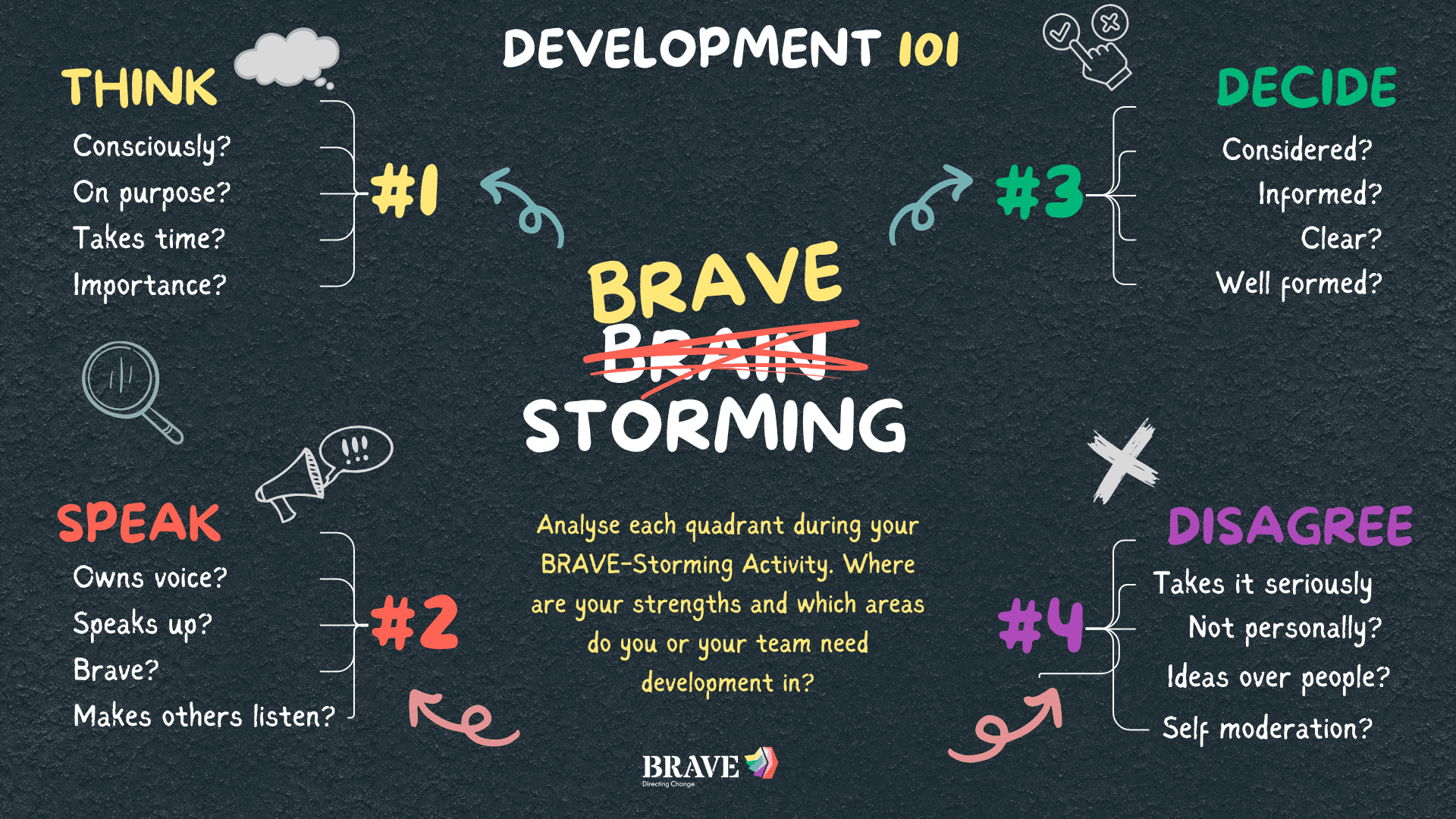
• Every voice matters and it’s safe to speak up

• Curiosity beats certainty and disagreement is encourgaged

• Differences aren’t threats, they’re invitations to learn more

.• Decisions are well formed and well informed

• Thinking about your thinking is the norm

Why This Matters Now

We’re living in a time where the past, present, and future are all happening at once. The pace of change is wild. The uncertainty is real. And the need for connection is louder than ever. Intergenerational conversations help us learn from what came before, make sense of what’s happening now and of course prepare for what’s next.

When we choose to ignore differences and assumptions, and instead embrace what they might mean it gets us onto the same page. Bravely, intentionally and imperfectly.

We can help you and your teams with BRAVE Conversations. Reach out if you’d like to explore it.

You can download your FREE Intergenerational Infographic below:

False Harmony: The Culture Killer

Every business has two stories: the one people tell, and the one people live.

A team can look calm and aligned; smooth meetings, polite nodding and some but not much challenge. Underneath, however, people are holding back and tension is building.

That’s false harmony: the appearance of agreement without the honesty that real alignment requires.

At We Are Brave, we see this pattern everywhere. It’s subtle, socially acceptable and one of the biggest blockers to courageous, psychologically safe cultures.

What is False Harmony?

False harmony is when people say “it’s all good” while really thinking:

So in reality, it’s not harmony at all. It’s silence dressed up as alignment.

Why it happens?

Teams drift into false harmony when:

The real cost

A conflict free veneer can hide real underlying damage:

What real harmony looks like

Real harmony isn’t about avoiding conflict, it’s about honest disagreement held with respect and shared purpose.

It sounds like:

How We Are BRAVE helps

We help organisations build cultures where people speak up truthfully and stay connected. Where leaders invite challenge and discussion. Where teams learn to disagree well and debate with purpose and importantly, where psychological safety is lived, not imitated.

Through leadership development, team programmes, coaching, and learning experiences, we help teams move from performing false harmony to practising real honesty, and when that happens, decisions sharpen, relationships strengthen, and teams become more BRAVE.

If this sounds like your business, then reach out today. We’d love to help.

Ethical Decision Making Toolkit

Ethical decision making has become one of the most charged, high stakes conversations of 2026 so far.

The world we work in is shifting fast and both people, and businesses need to be able to step up and show the ethics that live behind their decisions.

As everything becomes more transparent in a world with maximum exposure this will become an essential skill for all managers and leaders.

This free toolkit is your guide to creating the right culture to bring this to life.

Need help? We’d love to support you on your journey. Reach out and start the conversation today.

The Rapid Rise of Ethical Decision Making

In 2026, ethical decision making is no longer a “nice to have” or a compliance module buried in an LMS. It’s becoming the heartbeat of many organisational cultures, the place where trust is either built or quietly eroded. And for a training business like ours, one that spends its days helping people speak up, disagree well, and be brave, this moment feels both urgent and full of possibility. Let us tell you why:

Because silence is no longer neutral
When people don’t feel safe to question a decision, challenge an assumption, or name a risk, businesses can drift into ethical blind spots. Not because anyone is malicious, but because fear is louder than integrity. We see it every day: talented people holding back insights that could prevent harm, spark innovation, or protect a team’s reputation.

Because complexity demands more than technical expertise
Brave leaders are navigating dilemmas with no clean answers: AI bias, data privacy, climate impact, hybrid‑work fairness. These aren’t problems you can solve with a policy alone.
They require teams who can slow down, think critically, disagree constructively, and bring to the surface perspectives that would otherwise stay hidden.

Because values only matter when they’re lived out loud
Organisations are being asked to “show their working”, in order to demonstrate not just what they decided, but how they got there.
That level of transparency is impossible without a culture where people feel able to question, challenge, and contribute.

Because bravery is a skill, not just a personality trait
We train people every day who think bravery belongs to someone else, the extroverts, the senior leaders, the C-Suite, the natural born disruptors. But ethical decision‑making thrives when bravery is distributed, not concentrated. It could look like:

Because the future will reward businesses who choose integrity over ease
The organisations that will thrive in 2026 and beyond are the ones who treat ethics as a living practice, something that is shaped by everyday conversations, not annual statements. And that’s why our work matters. Every workshop, every coaching session, every moment where someone finds their voice contributes to a culture where ethical decisions aren’t left to chance.

Interested in us supporting you? We’d love to help. Start the conversation today.

BRAVE Leadership Lessons

Ask any leader worth their salt 🧂 how they developed their own, unique leadership style and they’re sure to talk about the lessons they’ve learned along the way.

We’re so lucky to work with an incredible array of clients from a wide range of industries that has given us a little extra insight 🔭 into those lessons.

Add that to our own experiences and we suddenly had a leadership recipe too good not to share with you.

Click to get your 10 Leadership Lessons in a quick and easy downloadable format.

If you love this then share it ⬆️ or save 💾 it!

8 Ways a Leader Empowers a Team

The days of command and control are long gone (mostly!).

Modern leaders need to be visible, strategic, engaging and held to account.

One way to help is to ensure that brave leaders are empowering their teams.

Micro management is not required!

Enjoy this free download on 8 ways to do it. If you love it, then share it.

Brave New Year, Brave New You: Why 2026 Is the Year of Skill Building

There’s something about stepping into a new year that automatically invites a personal reset.

Now we don’t mean the dramatic, overnight transformation promised by diets, shakes, injections (no shame!) and early morning gruelling runs, but a quieter, more grounded kind of renewal….phew! 😮‍💨

We called this out back in November when we shared our BIG 6 Skills for 2026! We’ll link that download at the end of this post. #toldyouso

We’re all living in a moment where technical expertise matters, but human skills are what set people apart. AI is growing but it lacks our empathy and emotion. Leaders, teams, and organisations are recognising that growth isn’t just about doing more, it’s got to be about doing things with clarity, confidence, and integrity.

That’s why we think this will be the year of intentional skill building. People are carving out time to strengthen the capabilities that actually move their dial: setting healthy workplace boundaries so energy goes where it matters, working to develop emotional intelligence to navigate relationships with more ease, and sharpening those all so important ethical decision‑making so choices align with values (even when the pressure is on).

The best part?
These aren’t abstract ideals. Topics that are unreachable. These are practical, learnable skills that make work feel more sustainable and leadership feel more human.

Another easy win?
You don’t need a massive overhaul to begin your skills development. Some small, consistent steps, such as taking a short course, joining a webinar or workshop, or simply committing to some monthly professional development in some form can create momentum for you that lasts far beyond January.

So if you’re stepping into 2026 with a desire for growth, consider this your invitation from us!

Not to reinvent yourself, but to invest in the version of you that’s already emerging: more grounded, more skilled, and more aligned with the life you want to lead.

You can grab your free copy of The BIG 6 Skills for 2026 here. 👇

Sara and Rhi. 

New Year, New You Toolkit

A new year is the perfect time to introduce small but powerful changes to boost your focus, wellbeing and personal growth.

In this free New Year, New Me toolkit we’ll share 4 small, yet incredibly simple habits that can help you make the changes you need to welcome in the new you.

Download your copy here:

10 Habits for BRAVE Opportunities

If you are looking for the next BRAVE step then you might be interested in this guide.

We’ve detailed the habits we see BRAVE people demonstrating that help them to get the best opportunities.

Download your FREE copy here:

6 Time Management Tips from CEOs

Harvard Business School is among the world’s most trusted sources of management education and thought leadership.

We took inspiration from their study on the behaviours of a range of 27 top-performing CEOs, tracked over 60,000 hours, across a three month period.

This guide details the six tips that emerged from the Harvard School research.

⚠️ Legal Notice ⚖️
We Are BRAVE cannot be held responsible for any dramatic increases in efficiency, organisation or performance after using this guide. 😉